
What you need to thrive
There is a question that sits underneath almost every difficulty a person brings to counselling. It doesn't always arrive in those exact words, but it's hidden in the exhaustion, the disconnection, the quiet soundtrack of: what is missing?
There is sometimes a quiet shame that accompanies need. Many of us learned early that our needs were too much, too inconvenient, or simply not the priority. So we called it selfish and were taught to manage, and swallow them silently. And so, with time, needs go unspoken, unmet, and eventually become ghosts that haunt us, but that we can't name.
The lost pyramid of need — is it also misunderstood?
If you have read the blog post on nutrition, you have already heard me mention Maslow; a simple, well recognised, diagram that many have glanced at: survival at the base and self-actualisation at the peak. Most people have encountered it at some point in school, at uni or on their own journey of self discovery, but I wonder how many have sat with it long enough to understand how vital this little pyramid actually is.
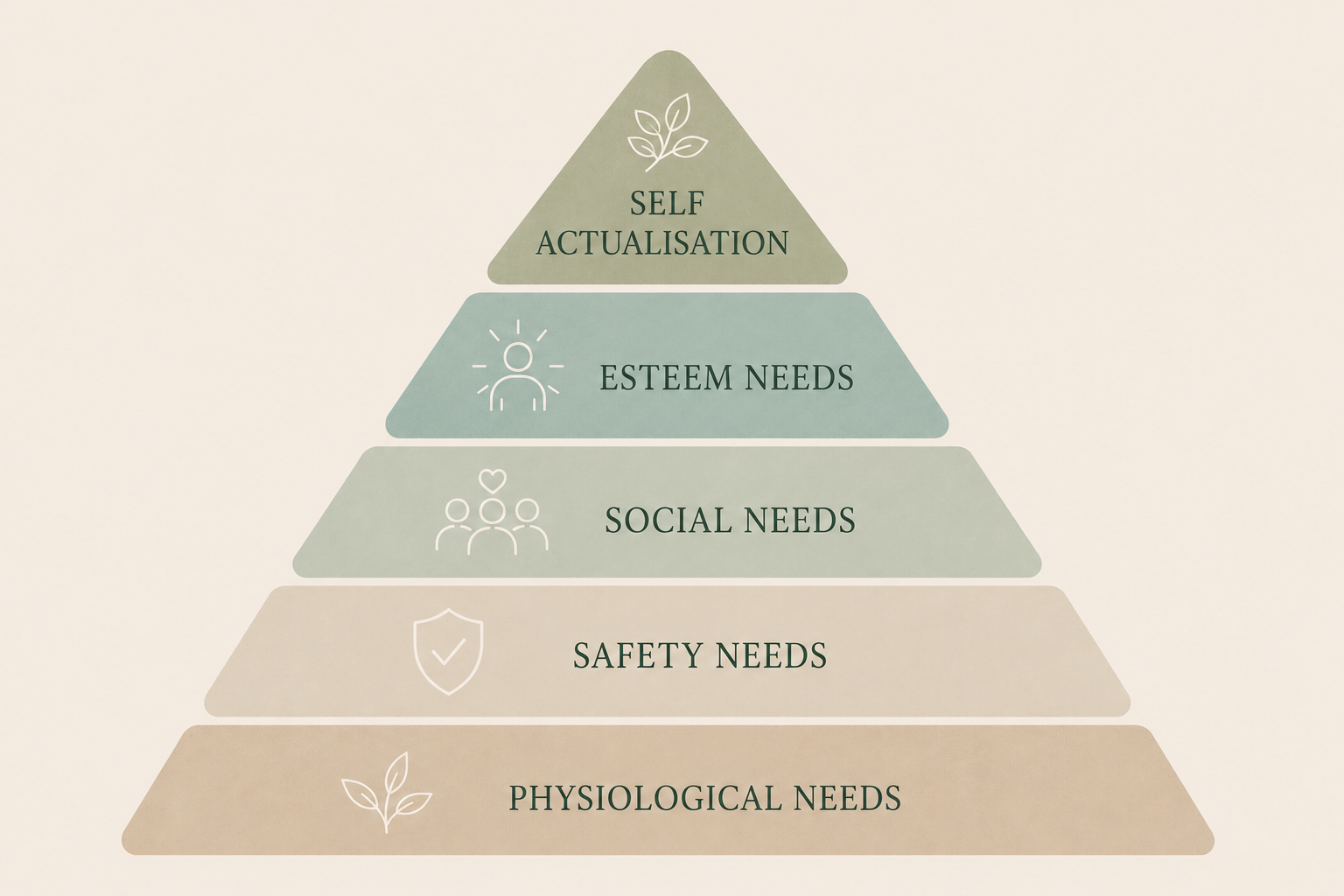
Maslow Hierarchy of Needs
The core idea is this: human needs are not all equal. Some are so fundamental that when they go unmet, everything else becomes secondary. Food, water, warmth, safety — these must be sufficiently in place before we can genuinely focus on belonging, esteem, or growth. Maslow's insight wasn't just a tidy diagram. It was an argument that unmet needs don't disappear — they become the loudest voice in the room, driving behaviour and blocking growth, whether we're aware of it or not.
That's why in counselling I address the foundation first: Do we need to sort out your sleep? Is your living situation stressful? How are your dietary habits? How are you experiencing work? Whether someone has lived in a state of chronic stress for years, or a recent breakdown in a relationship is causing them to lie awake at night refusing to eat — the body registers all of it as a survival signal. There is no bandwidth for emotional work when the system believes it is simply trying to survive the day.
A person who doesn't feel safe, in their body, in their relationships, in their home, cannot fully access the work of understanding themselves. The brain won't allow it. When safety is absent, survival takes over. Once the foundations are sufficiently met, something shifts: The body finally feels safe enough to explore itself.
Adding more depth — what is your unique lens?
Around the same time that Maslow's pyramid was making its way into psychology textbooks, a psychiatrist named William Glasser was developing something complementary, and in some ways, more personal. I enjoy incorporating Glasser's Choice Theory into the therapeutic process, as it addresses our psychological needs as the driving force behind our behaviour.
Glasser proposed that each of us develop what he called a Quality World: a deeply personal internal picture of everything that matters most to us. The people we want to be close to, the experiences we want to have, the values we want to live by. It begins forming during your childhood and becomes the lens through which we see the world. This quality picture shapes our needs to be unique, and a finger print designed to see our ideals fulfilled, but expectation gaps and unmet needs can create a divide. To close this, the driving force of it all, according to Glasser, are our five basic psychological needs wired into us from birth: survival, love and belonging, power, freedom, and fun. Not in a hierarchy, but as an interconnected set, requiring attention across our lifetime, constantly shifting.
When needs go unmet
I would like to mention the most significant piece of public health research of the last thirty years: the ACEs study — standing for Adverse Childhood Experiences. Researching nearly 20,000 subjects over a span of decades, it found that children who experience neglect, abuse, or chronic instability don't simply move past those experiences as they grow up. Adverse childhood experiences can disrupt healthy brain development and fundamentally alter how the body responds to stress across an entire lifetime.
What ACEs research is documenting, is the long-term cost of unmet needs in the formative years. A child who doesn't feel safe cannot develop normally. A child who isn't loved cannot learn to regulate their emotions. And that learning doesn't simply disappear at eighteen; it carries on, and can show up later as chronic illness, addiction, and deeply ingrained unhealthy patterns.
I want to draw your attention to this because the same principle applies in adulthood, even when the damage is less severe, unmet needs don't disappear. Instead, they drive behaviour and show up in our bodies in different ways. Getting sick constantly, overworking to feel a sense of worth. Staying in relationships because leaving feels more frightening than staying. Numbing and dissociating to create temporary relief and withdrawing when the nervous system has simply had enough or disappointment becomes to real.
Awareness and understanding are the first step
What both Maslow and Glasser understood, and what I find myself returning to again and again, is that awareness is the turning point.
You cannot meet a need you haven't named. You cannot make a different choice if you are unable to notice the one you are making right now. But once the map becomes visible, many things fall more easily into place.
Glasser was particularly clear on this, and I appreciate his empowering philosophy: human beings don't have to remain victims of their history or their circumstances. They are capable of making responsible, conscious choices to meet their needs in ways that are healthier, more aligned, and more genuinely satisfying. Not by force or willpower, but through understanding, compassion, and communication. That belief sits at the heart of what counselling offers; not telling you what you need or how to get it, but creating the space to figure that out for yourself.
Change doesn't happen all at once. It happens slowly, quietly, in the small moments you choose something different. Sometimes that begins with the simplest question of: Are my needs being met, and how am I meeting them? Am I feeling safe and cared for? Do I have relationships in which I feel truly seen and known? Do I have a sense of agency? Is there space in my life for play and for things that bring me genuine joy?
Answering these questions can feel raw, vulnerable, and even heavy — especially if the answer is mostly no, or even I don't know. Remember, there are no wrong answers. The good ones are the honest ones. Begin by taking stock, checking in with yourself, and meeting what you find with curiosity and understanding.
Sources & Further Reading
Maslow, A.H. (1943). A theory of human motivation. Psychological Review, 50(4), 370–396.
Glasser, W. (1998). Choice Theory: A New Psychology of Personal Freedom. HarperCollins.
Felitti, V.J. et al. (1998). Relationship of childhood abuse and household dysfunction to many of the leading causes of death in adults: the ACEs study. American Journal of Preventive Medicine, 14(4), 245–258.
Centers for Disease Control and Prevention (2024). Adverse Childhood Experiences (ACEs). CDC Violence Prevention.
Tay, L. & Diener, E. (2011). Needs and subjective wellbeing around the world. Journal of Personality and Social Psychology.
Wubbolding, R.E. (2015). The voice of William Glasser. Journal of Mental Health Counseling, 37(3), 189–205.
